
Overwork, Out of Class Duties, and Reclassification
Workload issues and overwork has been a major issue among staff at UC, and was a major driver for UC staff to organize their union in the first place. Without a union, workers had no recourse when they were being overworked, and the only way they could get compensation for their extreme workloads was to request a reclassification, which was often denied.
In our new contract, UC staff have won strong protections against overwork, guarantees of compensation for performing duties that are beyond the scope of their job, and an enforceable process for reclassifications when they are systematically asked to perform duties beyond their classification.
Reduction of assigned duties: if you are being assigned duties that exceed a reasonable workload based on your FTE, you can discuss the excess duties with your supervisor to ensure your workload and compensation are in alignment, and reduce those duties if they are not
Stipend/temporary compensation: your union contract clearly establishes the right to additional compensation when taking on excess work
Reclassification: if you are systematically and indefinitely being asked to perform duties that are outside your job description, your contract lays out an enforceable process to be reclassified so that your title and compensation match the duties you are performing
If you have been experiencing an unreasonable workload, keep track of changes to your workload, and connect with your coworkers on what you all might be collectively experiencing. Use the UAW 4811 Workplace Issue Form to get connected with a peer organizer at your campus and to strategize next steps on how to enforce your rights and protections.
With all these new tools, it is important for us to identify the underlying problem causing the overwork in order to choose the right path to resolution. The process differs slightly for exempt (salaried) and non-exempt (hourly) workers.
Salaried Workers
Key concept: “Required work schedules must be reasonable”
This provision in the Workload/Hours of Work article of your contract makes clear that you cannot be asked to systematically work unreasonable hours. For exempt, salaried employees, a standard full time workweek generally comes out to 40 hours a week. While working over 40 hours may happen, this should only happen occasionally as operational need demands or for temporary situations, such as workload ebbs and flows during the academic quarter/semester that eventually slow down, lessen, and return to a standard workload. If unusually heavy work periods happen for an extended length of time, you have the right to request a temporary reduction in your work schedule with no loss of pay.
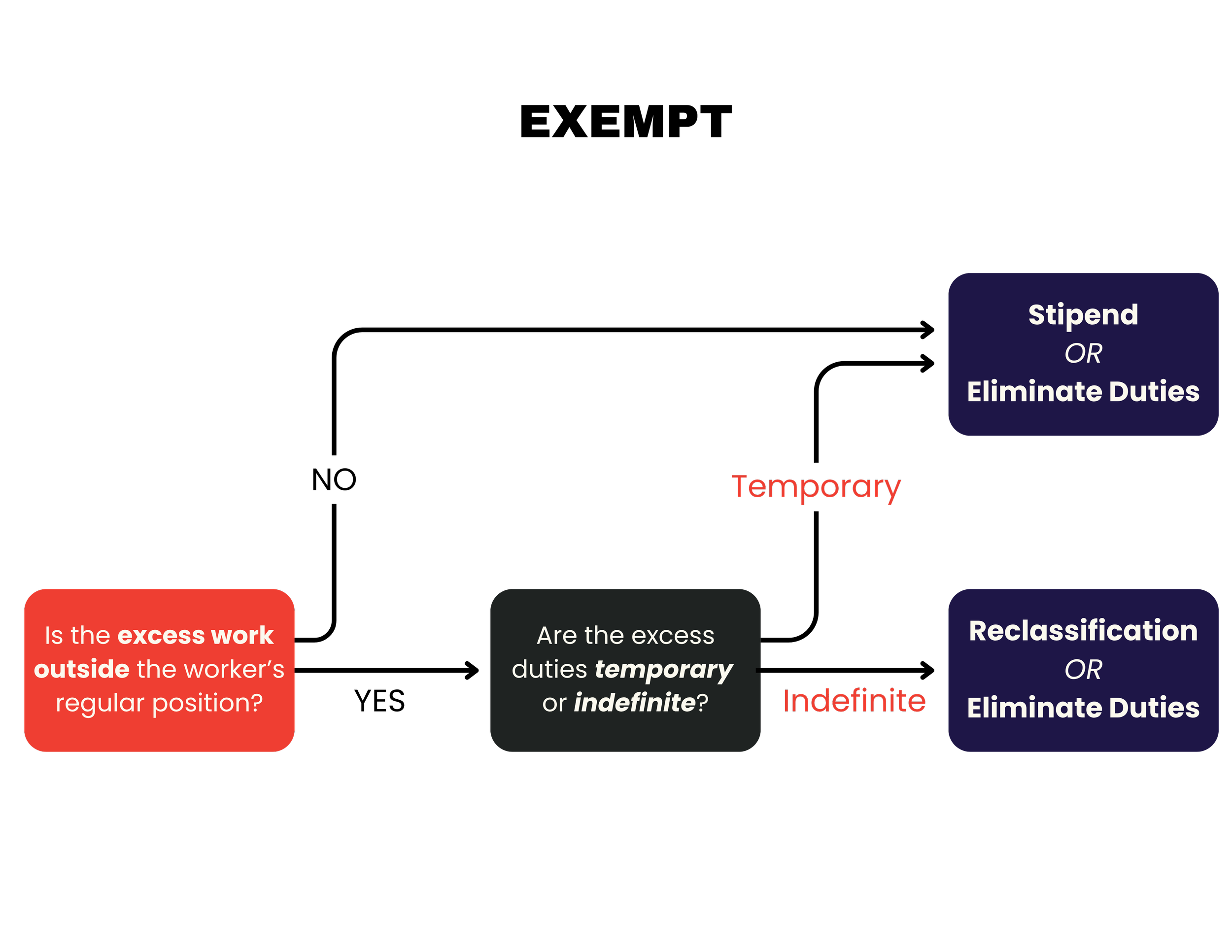
The flowchart above describes how you can decide what the appropriate resolution is for your particular overwork situation. If the duties you are performing are consistent with your regular position, but are simply in a higher than typical or reasonable volume, you have the right to receive a stipend to provide additional compensation for the additional work, or simply have those duties reduced. Similarly, if the excess duties are outside of your regular job, but they are temporary, with a defined end date in the next year, a stipend or elimination of the duties would be appropriate. Under our contract, stipends, and the excess work they accompany, should be temporary and should not exceed 25% of a worker’s base salary.
-
Hi [name of supervisor],
I am writing to follow up on the additional, temporary duties I have been [performing since [date]/been asked to perform]. I’m inquiring about the next steps for the corresponding stipend that I should be provided. I have reviewed my collective bargaining agreement between UAW and UC, and have determined that, based on working [X hours/week] I should be paid a [X%] stipend for the duration I am performing these additional duties.
[If CC’ing union emails, add]: I understand you may not have been advised about the specifics of stipends and performing additional duties as outlined in my collective bargaining agreement, so I am copying HR, and UAW representatives on this email so that everybody can be on the same page.
I am happy to answer any questions that you may have about the additional duties. I look forward to hearing the next steps in the process of my stipend.
Best,
[worker name]
If the excess duties are outside your regular position and are in place indefinitely, you have grounds to request a reclassification. Specifically, if you have been (or are expecting to be) performing these excess duties for over 12 months, you can request a review of your classification using the enforceable process in our contract.
Hourly Workers
Key concept: record all hours worked!
UC staff have long been told by their supervisors that they cannot pay overtime, they simply have to get the work done. Some of the more creative managers may have even told their staff to “flex” their time, not reporting hours worked in exchange for leaving work early on a different day. While these practices have long been violations of the law, workers did not have any recourse other than filing a lawsuit against the University in the face of this wage theft.
Under our new union contract, non-exempt workers have clear and enforceable protections about being paid for all time worked, including overtime and on-call time. But these protections are only strong if we enforce them, as that starts with pushing back against the culture of working for free. If your supervisor says that they can’t pay any overtime, communicate clearly about what work will be unfinished or delayed as a result of you stopping your workday after 8 hours. If your supervisor pushes back or rejects your timesheets after you accurately report overtime hours when you were directed to finish your work assignments, fill out our union’s Workplace Issue Reporting Form, and a peer union representative from your campus will then reach out to discuss the situation.
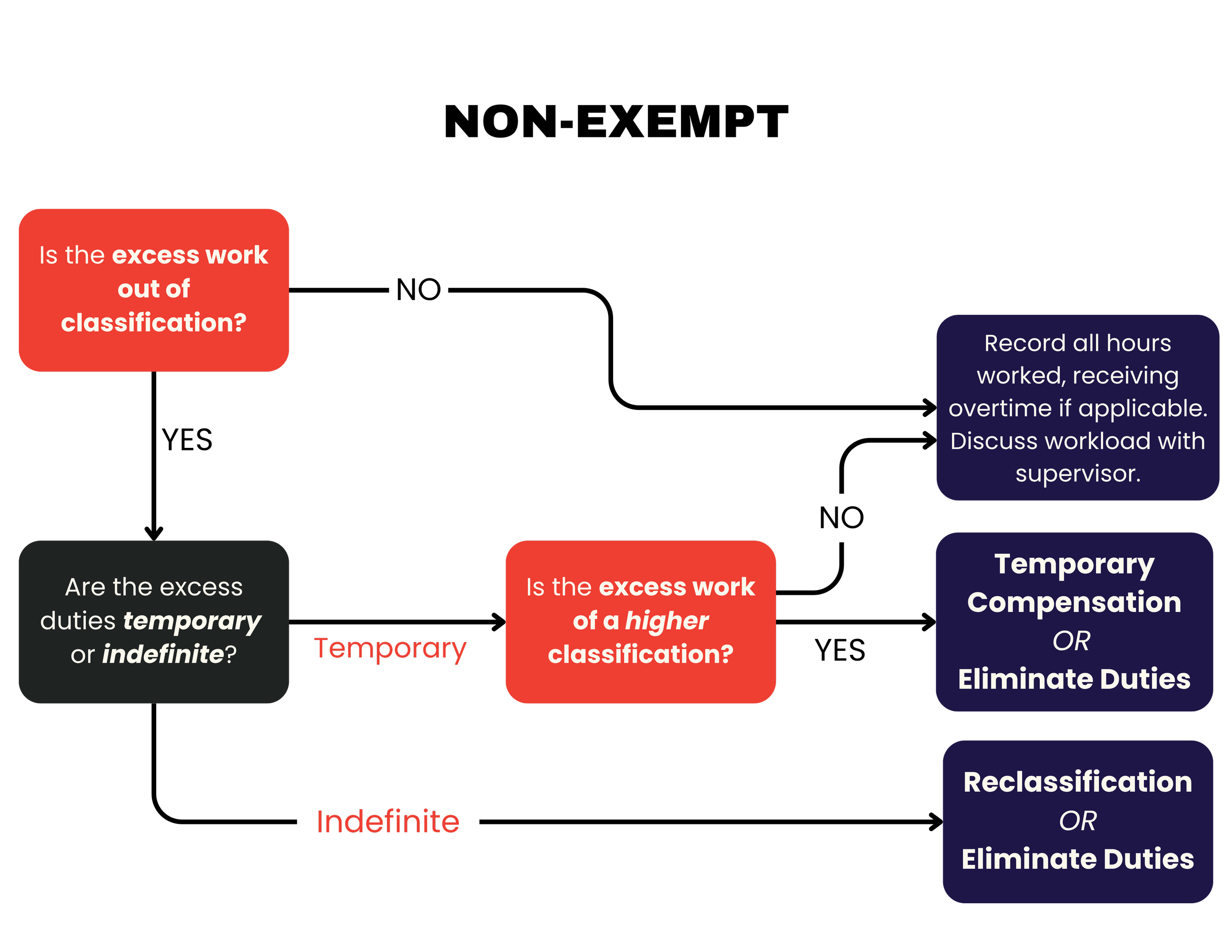
The flowchart above describes how you can decide what the appropriate resolution is for your particular overwork situation. If the excess work consists of duties typical for your classification, but simply go beyond your normal workload, be sure to record and report all hours worked, including overtime if applicable. In addition, you can initiate a discussion with your supervisor about your workload and attempt to agree to a work schedule and duties that meet your needs.
-
Hi [name of supervisor],
I am writing to start a discussion about my work schedule and workload. [describe your current workload and how it has been impacting you] I was hoping we could meet to review my current work assignments and schedule, and see if we can come up with an arrangement that works for both of us. Can we find a time to meet to talk about it? I’m available [times within the next 15 days].
Best,
[worker name]
Duties that are not part of your regular job may be grounds for temporary compensation if they are of a higher classification. If you have been asked to temporarily perform duties from a higher job classification that you would not otherwise perform, you have the right to request temporary compensation at either the minimum of the pay range associated with those duties or 4% above your current rate of pay, whichever is higher.
-
Hi [name of supervisor],
I am writing to follow up on the additional, temporary duties I have been [performing since [date]/been asked to perform]. Since these duties are not part of my job classification and are from a higher classification, I am eligible for corresponding out of classification temporary compensation. I have reviewed my collective bargaining agreement between UAW and UC, and have determined that I should be paid [whichever amount is higher: X minimum $ of the higher position’s range OR at least 4% increase] for the duration I am performing these additional duties.
[If CC’ing union emails, add]: I understand you may not have been advised about the specifics of out-of-classification pay as outlined in my collective bargaining agreement, so I am copying HR, and UAW representatives on this email so that everybody can be on the same page.
I am happy to answer any questions that you may have about the temporary compensation. I look forward to hearing the next steps in the process of my out-of-class pay.
Best,
[worker name]
If the excess duties are outside your regular position and you are expected to perform them indefinitely, you have grounds to request a reclassification. You can request a review of your classification using the enforceable process in our contract.
-
Hi [name of supervisor],
I am writing to follow up on our discussion about my workload. You mentioned that I cannot work any overtime for these duties. I wanted to let you know about the work tasks that are going to be delayed as a result of not being able to work overtime. [describe what tasks you will not have time to perform in the regular work day, and thus will need to be delayed or skipped] I just wanted to make sure we’re on the same page about what is accomplishable in the available time. If these duties are urgent, please let me know so I can work the hours needed to complete them.Best,
[worker name]
Reclassification
If you have been assigned job duties that are outside your job classification that are indefinite and not resolved by a stipend or temporary compensation, our contract lays out a clear, enforceable process to request a review of your classification. Reclassification reviews are submitted to your supervisor, who needs to respond within 60 days. If your supervisor does not respond, you can forward your request directly to HR, who needs to respond within 90 days of your initial submission.
Before submitting your request, work through these best practices:
Collect your job description for your current classification and the desired classification
Identify work you are doing that falls under the job description of the desired classification
Assess if you have coworkers in a similar situation and make the request together if applicable!
-
Hello [supervisor name],
Our new union contract for staff provides for a process and timeline for a review of my reclassification. Please accept this email as my formal request for such a review and reclassification to [job classification].
I make this request based on [insert your rationale], and the work I do beyond the scope of an [your current job classification], including:
[list job duties that fall under the higher classification]
Thank you for your time and attention, I look forward to your response.
Best,
[your name]
If your request for a reclassification is denied, you have the right to appeal the decision, and can also file a grievance under our contract. Fill out our union’s Workplace Issue Reporting Form, and a peer union representative from your campus will then reach out to discuss the situation.
If your reclassification is approved and results in upward movement, you should receive a salary that is at least the minimum of the new salary range or 4% above your previous salary, whichever is greater.